
Surviving a Milpitas summer with a built-in Sub-Zero
Inland heat off the eastern foothills, dust from the dry season, and tight cabinet builds all push a Milpitas Sub-Zero harder in summer. What to watch, and when to act.
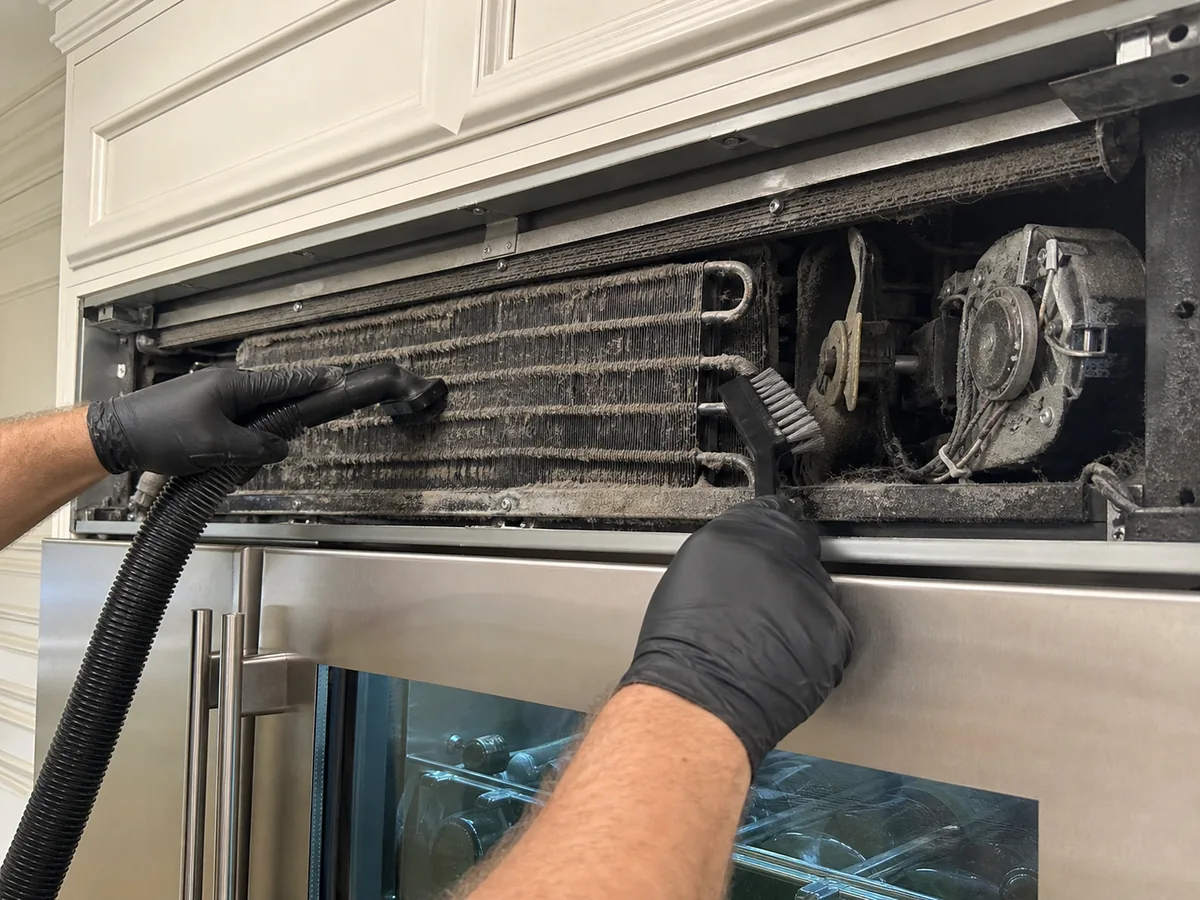
Milpitas sits at the base of the eastern foothills below Ed Levin and Monument Peak, far enough from the open Bay that the coastal fog rarely makes it this far inland. That gives the city long, dry, genuinely hot stretches from June through September — the kind of summer that a built-in refrigerator has to work through, not around.
A 48-inch Sub-Zero is built to handle it, but heat plus the fine dry-season dust we get along McCarthy Boulevard and out toward the Coyote Creek flats is exactly the combination that turns a quiet unit into a service call. Here is what changes in summer and what we tell Milpitas owners to keep an eye on.
Heat is a load, and the condenser feels it first
A built-in sheds its heat by pulling room air across a condenser coil behind the upper grille. When the kitchen itself is sitting at 80-plus on a July afternoon, the coil has less of a temperature gap to work with, so the compressor runs longer cycles to hold the same box temperature. That is normal — until the coil is also caked.
Milpitas's dry season throws a lot of fine dust into the air, and it settles into that coil over a summer. A loaded coil on a hot day is the single most common reason we get a 'it's not as cold as it used to be' call here between June and September.
Where the cabinet build makes it worse
A lot of newer Milpitas kitchens — the McCarthy Ranch builds and the homes that went up around the Great Mall corridor — set the Sub-Zero into a tight, handsome run of cabinetry with very little breathing room above the grille. That looks great and traps heat. In summer it can be the difference between a coil that stays clean for a year and one that loads up in a season.
We can't move your cabinets, but we can make sure the grille airflow path is clear and the coil is clean going into the hot months, which is most of the battle.
A simple summer checklist
Vacuum the upper grille area when you remember to, keep the area in front of it clear, and listen for a compressor that simply never seems to shut off on a hot day. If the freezer is fine but the fresh-food side is creeping warm, that is usually airflow or a tired gasket rather than anything in the sealed system.
A condenser cleaning and gasket check in late spring is the highest-value thing a Milpitas owner can do before the heat arrives. It is a small, fixed-cost visit that heads off the expensive call.
Questions & answers
Is my Milpitas Sub-Zero running constantly in summer a problem?
Longer cycles in genuine heat are normal. A compressor that literally never stops on a hot day, paired with a fresh-food side that is creeping warm, points to a loaded condenser or a tired gasket and is worth a look.
When should I schedule a pre-summer service?
Late spring is ideal — a condenser clean and gasket check before the dry inland heat sets in. It is a fixed-cost visit and far cheaper than the sealed-system repair a neglected coil eventually invites.
More Milpitas guides
- Temp Sensors · 4 min Sub-Zero Temperature Sensor Problems in Milpitas: Myths vs. Reality How a drifting Sub-Zero temperature sensor causes over-cooling and warm spots in Milpitas, and how to tell it from a board or sealed-system problem. Read the guide →
- Refrigerant Basics · 3 min What Refrigerant Does in a Sub-Zero and Why a Quick Top-Off Never Lasts (Milpitas) No - a Sub-Zero that lost refrigerant has a leak. Why a quick recharge fails in weeks, how leaks get found, and what a real sealed-system repair involves. Read the guide →
- Wine storage · 6 min When a Sub-Zero wine column drifts warm in Milpitas A Sub-Zero wine storage unit asked to hold 55°F in a hot inland kitchen lives a hard life. Dual-zone drift, sealed-system faults, and the repair-vs-replace call, for Milpitas owners. Read the guide →
Rather leave it to a specialist?
For service, call now or use the external online booking page.