
When a Sub-Zero wine column drifts warm in Milpitas
A Sub-Zero wine storage unit asked to hold 55°F in a hot inland kitchen lives a hard life. Dual-zone drift, sealed-system faults, and the repair-vs-replace call, for Milpitas owners.
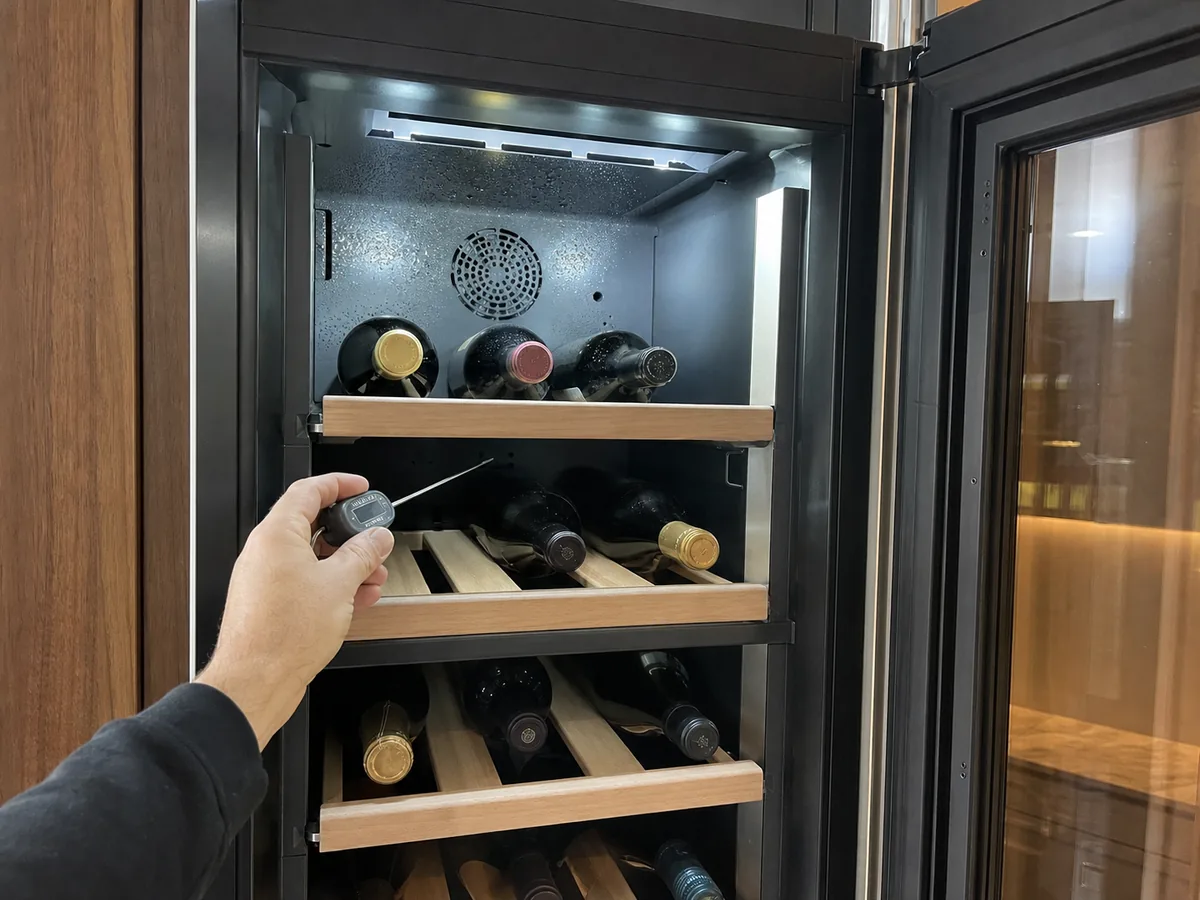
Sub-Zero is best known for its 48-inch fridge-freezers, but the same company builds some of the most respected built-in wine storage on the market — the 424 and 427 columns, the dual-zone undercounter units, the integrated drawers tucked into island runs. A growing number of Milpitas homes have one, often added during a remodel around the Great Mall corridor or in the newer McCarthy Ranch builds where the kitchen is the showpiece.
Unlike a refrigerator, a wine unit is judged on a single quiet promise: hold a steady cellar temperature, in the high-50s, with low vibration and the right humidity, for years on end. When that promise slips — a zone creeps to 64°F, a bottle goes off, the glass starts sweating — it is rarely dramatic. It is a slow drift, and it is worth understanding before you assume the worst.
Two zones, two sensors, two ways to drift
Most Sub-Zero wine units run dual-zone: an upper compartment for whites and sparkling near 50–55°F, a lower one for reds closer to 58–64°F, each with its own thermistor and its own damper or evaporator path. That independence is the feature — and it is also where most calls start.
When only one zone drifts while the other holds, the culprit is almost always local to that zone: a thermistor reading a few degrees off, a damper that no longer opens fully, or a duct iced over so cold air can't reach the bottles. A unit where both zones climb together is a different story — that points at the shared sealed system, not the controls. Telling those two patterns apart on the first visit is most of the diagnosis.
Heat, dust, and the inland Milpitas summer
Milpitas sits at the base of the eastern foothills below Ed Levin, far enough inland that the coastal fog stalls out before it reaches the city. The result is long, dry, genuinely hot summers — and a wine unit asked to hold 55°F in an 82°F kitchen is fighting a 27-degree gap that a beverage center in a cooler coastal town never sees.
That gap punishes the condenser. The fine dry-season dust that settles into Milpitas kitchens loads the coil behind the lower grille, the compressor runs longer to compensate, and a unit that held temperature for years suddenly drifts warm in July. Nine times in ten, a warm-running wine column here in late summer is a clogged condenser and a clean-up — not a failed compressor. Keeping that grille clear and the coil clean is the single highest-value thing a Milpitas owner can do for one of these.
Gaskets, UV glass, vibration — and when to replace
Beyond temperature, three quieter faults shorten a wine unit's life. A door gasket that no longer seals lets warm, humid kitchen air in, which both raises the temperature and fogs the inside of the glass. The UV-tinted glass door itself protects the wine from light damage; a failed seal around that panel undoes years of careful storage. And vibration — from a worn compressor mount or a fan bearing going dry — is uniquely bad for wine, because it disturbs sediment and accelerates aging in bottles meant to rest for years.
As for repair versus replace: a thermistor, a damper, a fan, a gasket, a control board — these are bounded, OEM-part repairs, and on a unit that cost several thousand dollars they are almost always worth doing. A genuine sealed-system failure — a refrigerant leak or a dead compressor — is the one case where, on an older unit, the math can tip toward replacement. We put gauges on it and show you the pressures before recommending either way; the $89 service call goes toward the repair, and our work carries a 365-day warranty on parts and labor.
Questions & answers
Only the red-wine zone of my Sub-Zero is warm — is the whole unit failing?
Usually not. When one zone drifts while the other holds its temperature, the problem is almost always local to that zone — a thermistor reading off, a damper stuck, or an iced-over duct. Both zones climbing together is the pattern that points at the shared sealed system instead.
Why does my wine unit struggle more in a Milpitas summer?
Milpitas summers run hot and dry with little coastal fog, so a unit holding 55°F in an 80-plus kitchen fights a big temperature gap. That, plus dry-season dust loading the condenser coil, is the most common reason a wine column drifts warm here in July and August — and it's usually a coil cleaning, not a major repair.
More Milpitas guides
- Temp Sensors · 4 min Sub-Zero Temperature Sensor Problems in Milpitas: Myths vs. Reality How a drifting Sub-Zero temperature sensor causes over-cooling and warm spots in Milpitas, and how to tell it from a board or sealed-system problem. Read the guide →
- Refrigerant Basics · 3 min What Refrigerant Does in a Sub-Zero and Why a Quick Top-Off Never Lasts (Milpitas) No - a Sub-Zero that lost refrigerant has a leak. Why a quick recharge fails in weeks, how leaks get found, and what a real sealed-system repair involves. Read the guide →
- Seasonal guide · 6 min Surviving a Milpitas summer with a built-in Sub-Zero Inland heat off the eastern foothills, dust from the dry season, and tight cabinet builds all push a Milpitas Sub-Zero harder in summer. What to watch, and when to act. Read the guide →
Rather leave it to a specialist?
For service, call now or use the external online booking page.